How to Calculate NOI From Cap Rate and Price
How to calculate NOI from cap rate: multiply price by the rate. See the math on a $500,000 listing, plus how to check the implied NOI against the rent roll.
By the NOICalculator.org team
To calculate NOI from cap rate, multiply the asking price by the cap rate written as a decimal. A $500,000 listing quoted at a 6.5% cap rate implies $32,500 of net operating income a year, or $2,708.33 a month. The usual direction runs the other way, where NOI and the cap rate set a property’s value. Listings print a price and a rate and leave the NOI out, so a buyer has to run the math backwards.
The formula: price times cap rate equals NOI
NOI = purchase price x cap rate
The cap rate is NOI divided by price. Multiplying undoes that division. Write the rate as a decimal first, so 6.5% becomes 0.065 and 5% becomes 0.05.
The answer is annual. Cap rates are always annual, so divide by twelve for a monthly figure.
Financing never enters it. Two buyers with different loans read the same implied NOI off the same listing.
Rounding changes the answer
The default property on this site is a $500,000 house renting for $4,000 a month, $48,000 a year. At 5% vacancy, effective gross income is $45,600. Taxes are $6,000, insurance $2,500, and 18% of collected income, $8,208, covers maintenance, reserves and management. Operating expenses come to $16,708 and NOI is $28,892, which is $2,407.67 a month and a 5.78% cap rate.
Now run it backwards. $500,000 times 0.0578 gives $28,900, eight dollars above the real $28,892, because the quoted rate was rounded to two decimals. On a $2,000,000 price, a rate rounded to the nearest tenth of a point can move the implied NOI by about $1,000. Read the result as a close range rather than an exact number.
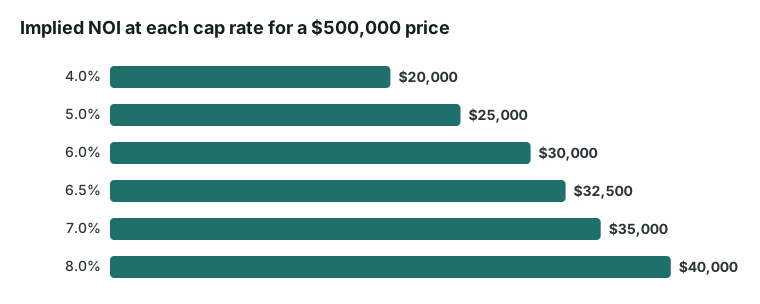
What a $500,000 price implies at each cap rate
| Quoted cap rate | Implied NOI | Per month |
|---|---|---|
| 4.0% | $20,000 | $1,666.67 |
| 5.0% | $25,000 | $2,083.33 |
| 6.0% | $30,000 | $2,500.00 |
| 6.5% | $32,500 | $2,708.33 |
| 7.0% | $35,000 | $2,916.67 |
| 8.0% | $40,000 | $3,333.33 |
Same house, same rent, same bills. The quoted rate alone decides how much income the listing is claiming.
Why the quoted cap rate may not be the market cap rate
A quoted cap rate is the seller’s own NOI over the seller’s own asking price. The seller picks both halves of it.
A market cap rate comes from recent sales of similar properties in the same area. Appraisers build value that way with the income approach, and it is the market rate, not the quoted one, that sets market value. There is no national figure to look up, so ask a local appraiser or broker for the range recent sales have printed. Our FAQ on what the two numbers do to value works through that gap.
Listings also lean on projections. The distance between a projected number and a historical one is the whole subject of pro forma NOI against actual NOI. Wikipedia’s entry on how capitalization rates are defined covers the standard definition.
Check the implied NOI against the rent roll and expense history
- Start with gross scheduled rent from the signed leases, not the asking rent.
- Subtract a vacancy and credit loss allowance you believe, 5% on the default property.
- List the expenses the owner will actually pay: tax bills, insurance quotes, utilities, repairs, management and reserves.
- Subtract those expenses from collected income. That is your NOI.
- Divide your NOI by the asking price. That is the cap rate you would really be buying.
Step five on the default property gives $28,892 divided by $500,000, or 5.78%. A listing quoting 6.5% on the same house claims $32,500, which is $3,608 more than the rent roll and the bills support. The NOI formula guide walks every line of that calculation.
So where does an extra $3,608 come from? Usually one of two moves.
- Trim the 18% allowance for maintenance, reserves and management down to 10%. That drops $8,208 to $4,560, leaves expenses at $13,060, and lifts NOI to $32,540, a 6.51% cap rate.
- Drop the vacancy allowance to zero. Collected income becomes $48,000, the 18% allowance becomes $8,640, expenses total $17,140, and NOI reaches $30,860, a 6.17% cap rate.
Neither move changed the building. Both changed the assumptions.
Signs the implied NOI is too good to be true
- An expense ratio under 30% on a property where the owner pays every bill. The default property spends $16,708 of $45,600, which is 36.6%.
- No management fee. An owner who self manages is still doing work that has a market price.
- No vacancy or credit loss line at all.
- No reserves for the roof, the HVAC or the water heater.
- Property taxes at the current owner’s assessment instead of the bill that follows a sale at the new price.
- Rents at market instead of what the leases collect. When all you have is a price and gross rent, the only ratio you can build is a gross rent multiplier.
Back into a price you would pay
Flip the formula once more: price = NOI divided by your target cap rate.
With $28,892 of verified NOI and a 7% target, the price is $412,743. At 6.5% it is $444,492, and at 6% it is $481,533. If the asking price is $500,000, your 7% number says the seller wants $87,257 more than the income supports at the return you need. That difference is your offer math, stated in dollars.
Run both directions on the calculator
Put the rent and the bills into the NOI Calculator and it returns NOI, the monthly figure and the cap rate on your price, ready to compare against whatever rate the listing quoted. The simple tab takes totals only: $50,000 of gross income, 5% vacancy and $17,500 of expenses comes to $30,000 of NOI.
Frequently asked questions
How do you calculate NOI from cap rate?
Multiply the price by the cap rate written as a decimal. At a 6.5% cap rate, a $500,000 property implies $32,500 of net operating income a year, or $2,708.33 a month. That is the seller's figure, and it sits before any loan payment. Treat it as a claim to verify against the rent roll and the actual expense history.
What NOI does a $500,000 price at a 6.5% cap rate imply?
$32,500 a year, because $500,000 times 0.065 is $32,500. This site's default property, the same $500,000 price with $4,000 of monthly rent, 5% vacancy, $6,000 of taxes, $2,500 of insurance and 18% of collected income for maintenance, reserves and management, produces $28,892 of NOI and a 5.78% cap rate. The 6.5% quote claims $3,608 more income.
Is the cap rate in a listing the market cap rate?
Often not. A quoted cap rate is the seller's NOI divided by the seller's asking price, and the seller chooses both numbers. A market cap rate comes from recent sales of similar properties nearby, and it moves with location, property type and condition. Pull comparable sales or ask an appraiser or broker for the local range first.
Can you find NOI from cap rate without the rent roll?
You can get an estimate, not a number to buy on. Price times cap rate only tells you what the seller's math produced. Without gross scheduled rent, a vacancy allowance, tax bills, insurance quotes and twelve months of operating statements, you cannot tell whether the implied NOI left out management, reserves or a reassessed tax bill.