How to Increase Shopping Center NOI: Recoveries, Vacancy, Mix
How to increase shopping center NOI: close the recovery gap, cut downtime between tenants, and use rent bumps. Worked numbers you can copy into the calculator.
By the NOICalculator.org team
How to increase shopping center NOI comes down to four levers: bill back more of what you spend, keep fewer units dark, raise rent on the schedule your leases already allow, and cut the costs no tenant reimburses. In retail, recoveries and downtime usually move the number further than asking rent does.
The arithmetic never changes. Effective gross income minus operating expenses is NOI, and the line items behave the way they do in NOI for commercial real estate. What changes in a strip center is where the slack sits.
Where a shopping center’s NOI actually comes from
A center’s income column has five parts:
- Base rent from the rent roll, unit by unit.
- Expense recoveries for taxes, insurance and common area costs.
- Percentage rent on tenant sales above a breakpoint.
- Specialty income: signage, pad sites, kiosks, storage, parking.
- Late fees and other charges.
Subtract vacancy and credit loss, then subtract the expenses the owner pays. Four of those five income lines are things you can act on this year.
Use the site’s default property as the baseline so every version stays comparable. A $500,000 property rents for $4,000 a month, $48,000 a year. At 5% vacancy, effective gross income is $45,600. Taxes are $6,000, insurance $2,500, and 18% of collected income, $8,208, covers maintenance, reserves and management. Operating expenses total $16,708 and NOI is $28,892, or $2,407.67 a month. That is a 5.78% cap rate.
Now read that same property as a four unit center, each unit at $1,000 a month, with the owner paying the bills and charging them back.
Expense recoveries: the gap between what you spend and what you bill
Common area maintenance charges cover parking lot upkeep, lighting, landscaping, snow removal, security and the management of shared space. Each tenant pays a pro rata share, usually by square footage. Taxes and insurance get billed the same way under most retail leases.
The owner pays $8,500 of recoverable cost here, the $6,000 of taxes plus the $2,500 of insurance. Suppose only $6,375 of it reaches an invoice, which is 75% recovery.
| Recovery | Income | Expenses | NOI | Cap rate |
|---|---|---|---|---|
| 75%, $6,375 billed | $51,975 | $16,708 | $35,267 | 7.05% |
| 100%, $8,500 billed | $54,100 | $16,708 | $37,392 | 7.48% |
That gap is $2,125 a year of NOI with no rent increase and no new tenant. Cap rates for small retail vary by market, location and tenant quality, so price the gap as a range: at 6% to 8% it is worth roughly $26,600 to $35,400 of value. NOI and cap rate covers why the multiple does so much of the work.
Gaps open for ordinary reasons. Vacant space has nobody to bill, so the owner absorbs that share. Caps and base years limit what you can pass through. Older leases exclude items newer ones include, and true ups get skipped.
So build a recovery schedule per unit straight from the leases, then set it against what you actually invoiced last year. The difference is your first target.
What does one dark unit cost?
A flat 5% vacancy rate hides the real risk. Retail vacancy arrives one unit at a time and tends to stay a while.
One $1,000 unit dark for six months costs $6,000 of rent plus about $1,063 of recoveries you can no longer bill, roughly $7,063 together. Run the year: collected rent $42,000, recoveries $7,437.50, income $49,437.50. Taxes and insurance hold at $8,500, and 18% of collected rent is $7,560, so expenses total $16,060. NOI lands near $33,378 against $37,392 for a full center.
At a 6% to 8% cap rate, that one vacancy costs $50,000 to $67,000 of value.
Downtime is a leasing speed problem more than a pricing problem. Track days from notice to signed lease, and from signed lease to rent commencement. Keep replacement prospects for each unit size, pre-approve an allowance for build out, and open renewal talks a year before expiry instead of ninety days.
Rent bumps, percentage rent and renewal options
Escalations you already wrote into the lease are the cheapest increase available. A 3% bump on $4,000 a month takes rent to $4,120, or $49,440 a year. Effective gross income becomes $46,968, the 18% line rises to $8,454, and NOI reaches $30,014 instead of $28,892. That is $1,122 for sending a notice on time.
Percentage rent adds a share of sales above a breakpoint. With base rent of $12,000 on one unit and a 6% rate, the natural breakpoint is $200,000 of sales. A tenant doing $250,000 pays 6% of the $50,000 overage, $3,000, and $2,460 of that survives the 18% management line.
That makes your tenant’s sales your business. Ask for sales reporting in every new lease, even where percentage rent does not apply, because it tells you who can absorb a bump and who cannot.
Renewal options cut both ways. A fixed renewal rate locks you out of market rent for years, so write options at fair market value with a floor. Under a gross lease the tenant pays one number and you absorb every cost increase, which is why retail leans on net lease structures instead.
Tenant mix and traffic: the slow lever
A center is one retail commercial property, not five separate rentals. An anchor tenant pulls the traffic that lets the small units pay more per square foot, and co-tenancy clauses can cut rent if that anchor leaves.
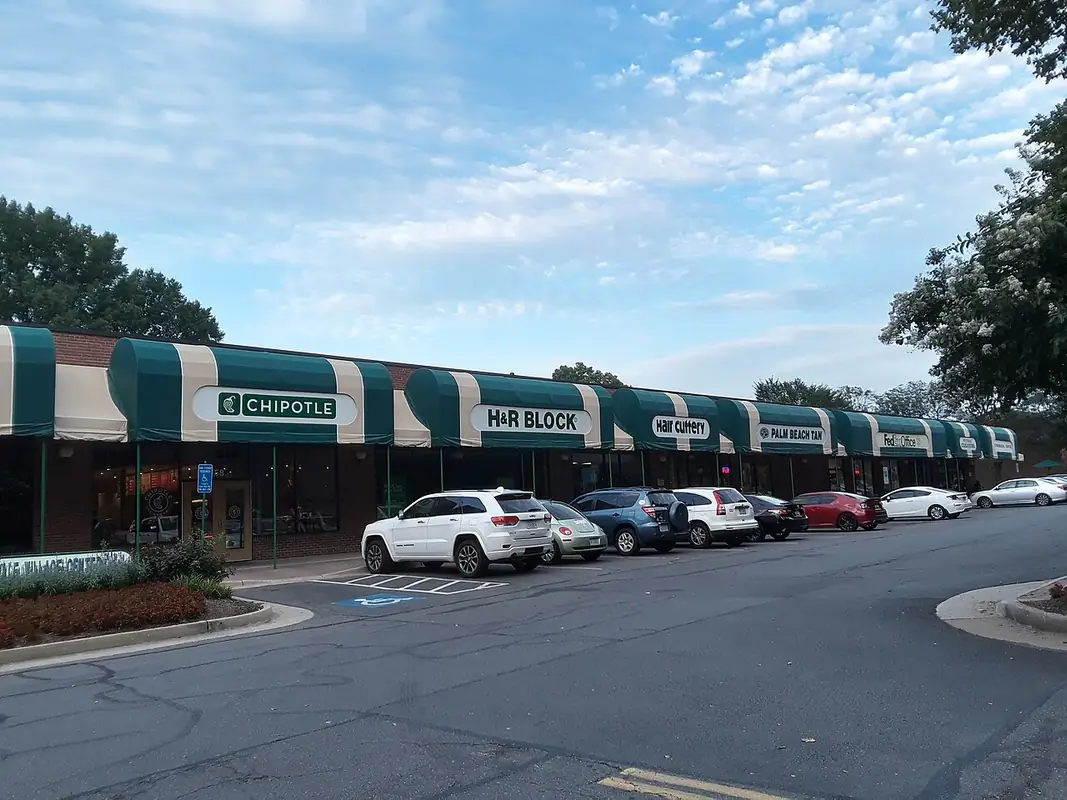
Mix complementary uses rather than the highest bidder for each vacancy. A center with daily needs traffic supports services that want the same customer.
This lever is slow. It plays out over lease terms, not quarters, so work it while recoveries and escalations pay you this year.
Cutting expenses without cutting the center
Sort every expense into recoverable and non-recoverable before you cut anything. Savings on a fully recovered line mostly flow back to tenants as smaller bills, while savings on a non-recoverable line drop straight into NOI.
Non-recoverable costs are the ones worth attacking: your management fee, owner level insurance, professional fees, bad debt and the vacancy share of everything else. A property tax appeal is still worth filing, because lower occupancy cost supports higher base rent at renewal.
Do not cut lighting, parking lot repair or security to buy a short term gain. Traffic falls, renewals get harder, and the vacancy cost above dwarfs the saving. Capital projects such as an LED retrofit sit below the NOI line, yet they lower the recoverable bills tenants pay.
For levers that apply to any property type, see 12 ways to raise NOI on a rental. For the same problem where occupancy and pricing change weekly, see raising NOI in self-storage.
Check your center in the NOI Calculator
Put your own figures into the NOI Calculator on the home page. Enter the price, annual rent, a vacancy rate that reflects real downtime rather than a habit, and your expense lines, then compare the result with and without full recovery.
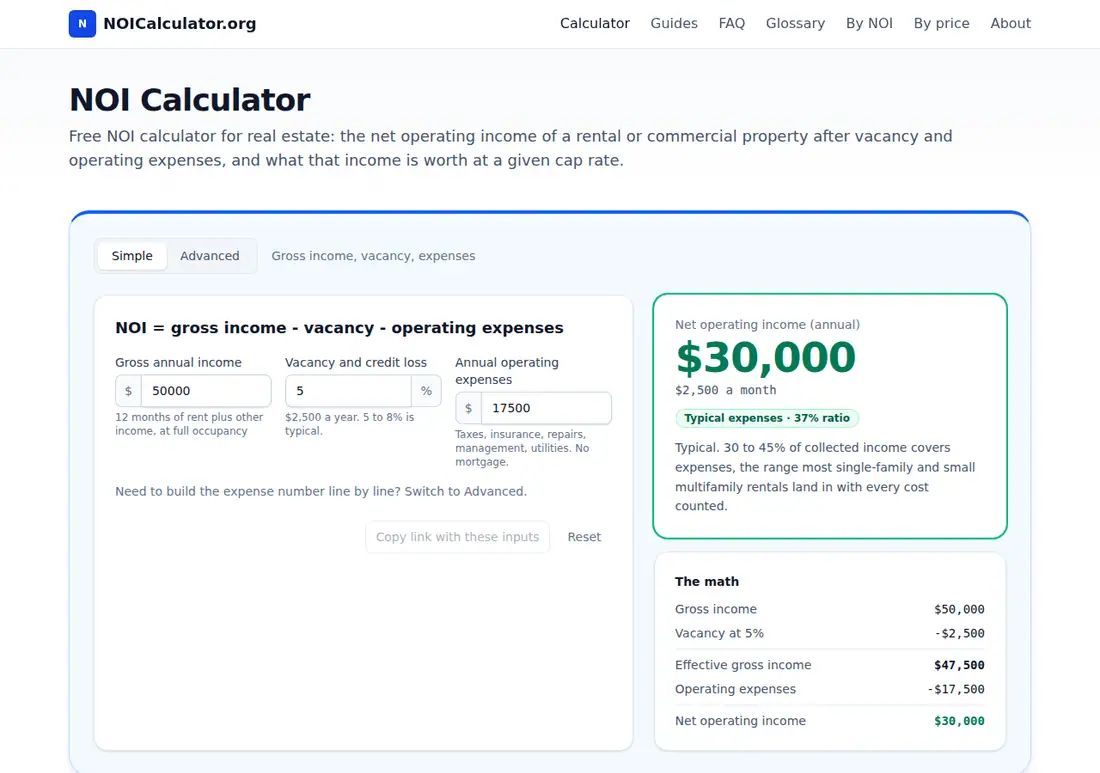
The simple tab is faster for a quick pass: $50,000 of gross income, 5% vacancy and $17,500 of expenses gives NOI of $30,000.
Frequently asked questions
How do you increase NOI at a shopping center?
Four levers move it. Recover more of the expenses your leases let you bill back, shorten the time units sit dark, apply the escalations and options already written into the leases, and cut the costs no tenant reimburses. On the site's default property, closing a recovery gap of $2,125 lifts NOI from $35,267 to $37,392 with no new rent at all.
What is a recovery gap?
The recovery gap is the difference between what you spend on recoverable items and what you actually bill tenants. It opens through vacant space with nobody to bill, expense caps and base years, exclusions in older leases, and skipped true ups. Spend $8,500 on taxes and insurance, bill $6,375, and the gap is $2,125 a year of lost NOI.
How much does one vacant unit cost a shopping center's NOI?
More than the rent alone. Split the default $48,000 of rent into four units at $1,000 a month. One unit dark for six months costs $6,000 of rent plus about $1,063 of recoveries you can no longer bill, roughly $7,063. NOI falls to about $33,378 from $37,392, and the value falls with it.
Does cutting a recoverable expense raise NOI?
Often barely. If the expense is fully recoverable and the center is full, cutting $1,000 of landscaping also cuts $1,000 of billings, so NOI stays flat. You keep the vacant share, so with one of four units empty you keep about $250. Non-recoverable costs are different: every dollar saved there is a dollar of NOI.
Is percentage rent part of NOI?
Yes. Percentage rent is extra rent a retail tenant pays on sales above a breakpoint, and it is operating income. If base rent is $12,000 a year and the rate is 6%, the natural breakpoint is $200,000 of sales. A tenant doing $250,000 pays 6% of the $50,000 overage, which is $3,000.